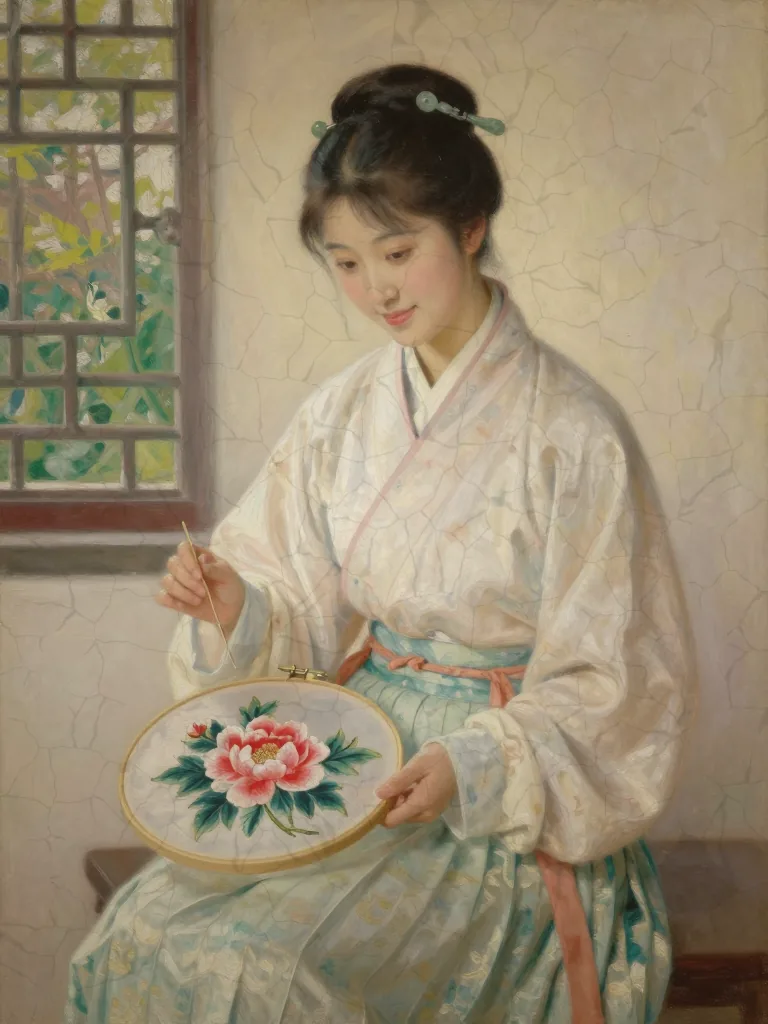
The Patient Needlesilk embroiderer in Suzhou
Your best work lives in the slow, careful parts.
This is your past-life portrait.
See my full result →You’ve matched this portrait before.
Your life in that era
- Early years
You grew up in the lanes of Suzhou, where your mother and grandmother were both embroiderers. Your childhood toy was a little embroidery hoop, and by seven or eight you could stitch a petal that looked real.
- Prime of life
Your work became famous in the city. Families planning a wedding or a birthday celebration all hoped you’d embroider a screen for them. You took on only a few pieces a year, each one taking months, yet no one ever complained about the wait.
- Later years
Later you took on several apprentices and taught them how to split a single silk thread into fine strands and how to match colors. You often told them that embroidery is like life: you can’t hurry it, you just take it one stitch at a time.
You, in that life
Personality
Mild and serene. You don’t say much, but you understand everything. You hold firm ideas about beauty and won’t settle for a color that’s even slightly off. Others think you’re slow; to you, slow feels solid.
Pastimes
You love looking at the flowers in the garden and keeping their colors in your memory, listening to the rain over a cup of tea, and now and then wandering the old streets with the neighbor girls to see what new colors of silk thread the shops have in.
A typical day
You embroider every morning while the light is at its best and rest your eyes in the afternoon. Your threads are sorted by color, one compartment each, and any half-finished piece is covered with a clean cloth.
Your six talents in that life
Anyone who matches this portrait will see their two strongest talents highlighted on their results page.
- Aesthetics85
You have a gift for color. For a single peony, you can use more than twenty shades of red.
- Perception70
The faces you stitch have such lively eyes that people say they look about to speak.
- Reason40
How much thread a large screen will need, which part to stitch first and which last: you work it all out before the needle goes in.
- Expression25
You’re not much of a talker, but your embroidery says plenty. Every handkerchief you give a friend hides a message only she would understand.
- Curiosity28
You love working out new stitches. Hear of a different technique somewhere, and you’ll ask someone to bring back a sample for you to study.
- Patience98
Splitting one thread into a dozen strands, spending most of a year on one screen: none of it ever feels slow to you.
Your natural talents
If you were a silk embroiderer in Suzhou in that life, it means you’re naturally good at these:
- You stay steady. While others rush for results, you can quietly see the whole process through.
- You notice the subtlest differences in color, in tone of voice, in a facial expression.
- What you make holds up to close inspection. The longer people look, the more care they see.
Little habits that life left behind
Sound familiar?
- Losing hours to a craft, a puzzle or handwriting without noticing
- Reaching for fabrics and little objects with a lovely texture
- Not wanting to tear the wrapping off a gift
A few words for you
No rush, one stitch at a time. Good things take their time.
You haven’t matched this portrait yet. Could this have been you in a past life?
Find out if this is youPortraits with a similar spirit
This is a playful self-reflection quiz, for entertainment only.
All portraits are original oil-painting-style works and do not depict any real person.