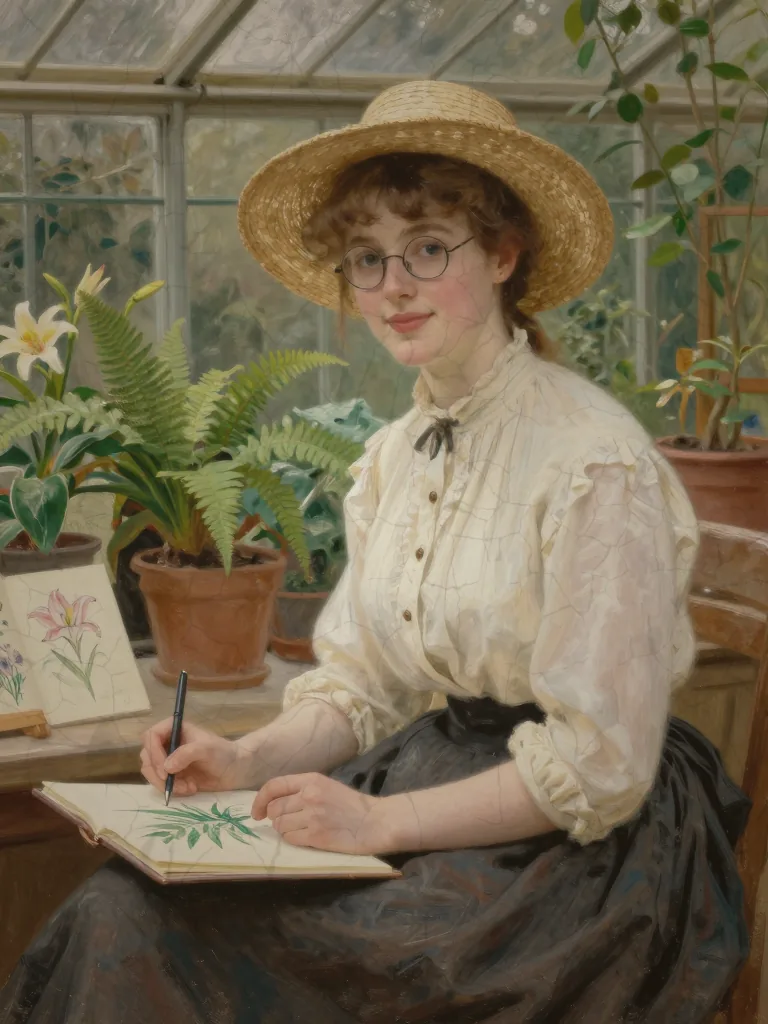
The Gathererbotanical artist in England
You find beauty where other people don’t think to look.
This is your past-life portrait.
See my full result →You’ve matched this portrait before.
Your life in that era
- Early years
You grew up in the countryside, your pockets always full of leaves, seeds and snail shells. The first picture you ever painted was a geranium on the windowsill, just about to bloom.
- Prime of life
Later you were invited to a great glasshouse to draw the new plants that arrived there. You went with botanists to valleys, coastlines and marshes and drew hundreds of plants, some of which were only given names later.
- Later years
Your drawings were bound into a thick field guide, with only your initials printed on the title page. In later life you planted a whole patch of wildflowers in front of your cottage and went out every morning to see if anything new had opened.
You, in that life
Personality
Quiet, focused and a little introverted, you light up and talk nonstop the moment plants come up. You can spend a whole afternoon drawing a single leaf. You don’t ask much of life: a pot of tea and a window full of light are enough.
Pastimes
You press flowers and make specimens, and after rain you love hunting for mushrooms and moss in the woods. When you write back to friends, you tuck a pretty leaf into the letter.
A typical day
Every morning you make a round of the glasshouse to see what has flowered and which leaves have changed color. When you finish a drawing, you always write the date, the place and the weather in the corner.
Your six talents in that life
Anyone who matches this portrait will see their two strongest talents highlighted on their results page.
- Aesthetics70
Your flowers aren’t just accurate; they glow. Through your drawings, many people saw for the first time how beautiful a fern frond can be.
- Perception55
You can tell when a plant is unhappy. A hint of yellow at the edge of a leaf, and you know whether it needs water or light.
- Reason75
You count the petals and measure the angles of the veins, so your drawings can be used to classify the plants.
- Expression25
Your pictures speak for themselves. Even children who can’t read can use your field guide to name the wildflowers by the road.
- Curiosity80
Hear of a plant you’ve never seen, and you’ll gladly take the longest mountain path to find it.
- Patience90
To catch a flower that only opens at dawn, you were in the glasshouse before sunrise every day for a month.
Your natural talents
If you were a botanical artist in England in that life, it means you’re naturally good at these:
- You can settle down to very fine, careful work. What others find tedious, you find calming.
- You notice the smallest beauties: wildflowers by the road, moss after rain, a leaf pressed in an old book.
- You have your own systems. Your collections, notes and photos are all neatly organized.
Little habits that life left behind
Sound familiar?
- Stopping on walks to look at the flowers by the path
- Filling your camera roll with plants and skies
- Always keeping a houseplant or two at home
A few words for you
Look slowly, and the world will hand you its details one by one.
You haven’t matched this portrait yet. Could this have been you in a past life?
Find out if this is youPortraits with a similar spirit
This is a playful self-reflection quiz, for entertainment only.
All portraits are original oil-painting-style works and do not depict any real person.